

Delegitimization – Reflection and Takeaways : From Blog Posts to Book
The purpose of “Delegitimization – Reflection and Takeaways” and these blog posts is to combine them into a published book entitled Safe Schools for Jewish Students: An Educator’s Guide to Preventing Antisemitism and Strengthening Belonging.
Go here for the full Table of Contents.
Chapter 3 – Delegitimization: Reflection and Takeaways
Delegitimization: Reflection and Takeaways
Educator Reflection Prompt
As educators, we all teach within frameworks shaped by our training, materials, and prevailing narratives. The questions below are not meant to assign blame, but to support reflection, balance, and growth in our practice.
- Indigeneity & Historical Framing
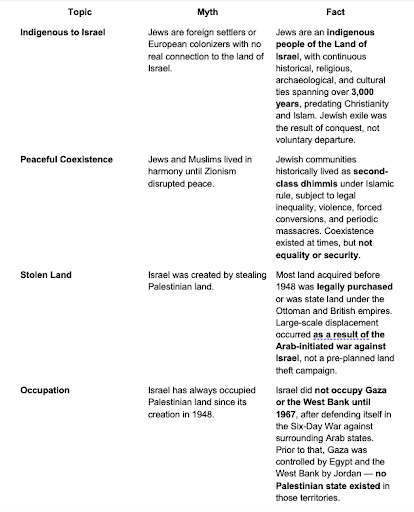
- Have I unintentionally framed Jewish history in Israel as beginning in the 20th century, rather than acknowledging its ancient and continuous presence?
- When I teach about indigeneity, do I apply the same standards consistently across all peoples, including Jews?
- Coexistence & Power Dynamics
- Have I presented pre-modern Jewish–Muslim relations as uniformly peaceful without exploring legal or social inequalities that existed at the time?
- Do I encourage students to examine historical nuance, or do I simplify history to fit a more comfortable oppressor vs. oppressed narrative?
- Land & Conflict Origins
- Have I used phrases like “stolen land” without examining legal land purchases, imperial land laws, or the role of regional war in displacement?
- Do I clearly distinguish between intentional dispossession and displacement resulting from war?
- Occupation & Chronology
- Have I implied that Israel has always occupied Palestinian territories, rather than helping students understand the post-1967 context and what existed beforehand?
- Do I emphasize timelines and causation, or do I rely on broad labels without historical grounding?
- Race, Identity & Power
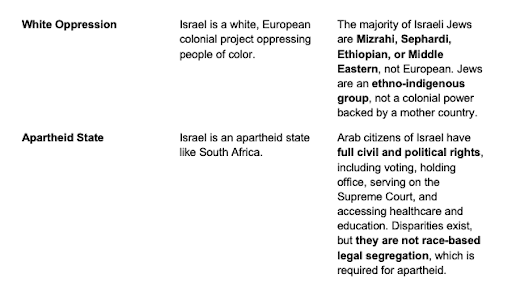
- Have I described Israel primarily through a white/colonial lens without exploring the ethnic diversity of Israeli Jews or Jewish indigeneity?
- Am I careful not to project modern racial frameworks onto ancient or Middle Eastern peoples?
- Apartheid Comparisons
- Have I used the term “apartheid” without ensuring students understand its legal definition and how it differs from inequality or national conflict?
- Do I help students differentiate between criticism of government policy and accusations that carry specific historical and legal weight?
- Classroom Climate & Student Impact
- Have I considered how Jewish students might experience these topics in my classroom?
- Do I create space for multiple narratives while ensuring that no group’s identity or humanity is delegitimized?
Mini-Toolkit for Teachers: Myths & Facts About Israel
Final Takeaway
Antisemitic or Not?
Once we recognize that the Jewish Israelis are indigenous to the land, are neither a “white” people nor a privileged people, avoided the expulsion of Arab Palestinians, and formed the State of Israel under the guidelines of International Law, we can no longer say Israel is an occupation of white colonizers.
If a person’s reaction to this knowledge is to say, “Based on this information, it was wrong for me to conclude that Israel should not exist,” then that person is coming from a place of learning, growth, and empathy.
If a person’s reaction to this knowledge is to say, “It’s still clear to me that Israel should not exist,” and searches for other reasons, then that person is coming from a place of seeking out justification for hating Jewish people.

Comment Below
Please comment below with edits or suggestions on what should be changed in this post.
Please keep your comments civil. Comments are moderated.
If you spot any comment out of line, let me know.
Join My Safe Schools for Jewish Students Newsletter
If you’re new here, subscribe to stay updated on new blog post excerpts of Safe Schools for Jewish Students: An Educator’s Guide to Preventing Antisemitism and Strengthening Belonging.
Sign up for my newsletter here.
Author Biography of Safe Schools for Jewish Students
Ezra Barany, son of a Bronx father and a Dutch mother from Nazi-occupied Netherlands, loves riveting readers with Jewish thrillers. His first two books in The Torah Codes series were award-winning international bestsellers. In his free time, he has eye-opening discussions on the art of writing novels with his wife and book coach Beth Barany. A high school physics teacher, Ezra lives in Oakland with his beloved wife and two cats working on the next book. Ezra, not the cats.
0 comments