

Myth 3 – Jews Stole the Land : From Blog Posts to Book
The purpose of “Myth 3 – Jews Stole the Land from the Palestinians” and these blog posts is to combine them into a published book entitled Safe Schools for Jewish Students: An Educator’s Guide to Preventing Antisemitism and Strengthening Belonging.
Go here for the full Table of Contents.
Chapter 3 – Myth 3: Jews Stole the Land
Chapter 3: Jews Stole the Land from the Palestinians as Expressed by the Nakba
“Israel is the Jew among the nations—expected to justify its existence every day.”
—Yossi Klein Halevi, Like Dreamers, 2013
Most Jews of Palestine Identified as Palestinian
Consider the time period before 1948, before the modern establishment of the State of Israel.
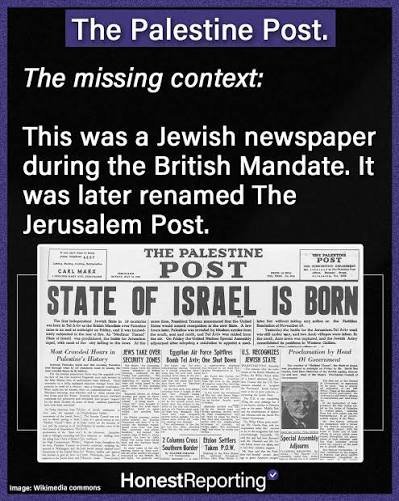
Whenever Jews were permitted to live in Palestine, there was a constant presence of them over the millennia. While a British Mandate, Palestine had the Palestine Post newspaper, the Palestine Orchestra, and the Palestine Football Team (soccer), all composed of Jewish people. The Palestine Post is now the Jerusalem Post.
Land Purchases and Evictions of Arab Palestinians
In the 1880s, Baron Rothschild funded the purchase of vacant settlements in the British Mandate of Palestine, encouraging Jewish people to immigrate and grow crops, like grapefruit and avocados.
Years later, Baron Rothschild bought Palestinian land from absentee landowners, like in 1929 from the Sursocks, a Greek Orthodox Christian family. The Arab tenant farmers who worked there and paid a tax to live there were evicted by the previous landowners with British assistance in enforcing the law: 1,746 families lost their homes. Though some received financial compensation, not all did.
The Arab Uprising
This issue of the British evicting the Arab tenants was one of the issues that instigated the Arab uprising against Jews in 1929, including the Hebron Massacre where 67 Jews were slaughtered. During the violence in Hebron, 19 Arab families protected Jews, hiding them in their homes. At the end of the fighting, 133 Jews were killed as were 110 Arabs, most of them by British security forces.
The issue of the Sursock purchase was taken up in the 1930 Shaw Commission, a British Inquiry. The Shaw Commission recommended that the British government reconsider Jewish immigration and land sales to Jews.
Though the Passfield White Paper was a formal statement of limiting Jewish immigration and land sales to Jews, a few months later, the McDonald letter of 1931 effectively overturned the White Paper, endorsing a Jewish state and encouraging Jewish immigration.
Arab Palestinians Who Lost Their Land Before the Nakba
In 1931, the British created a registry to determine how many Arabs were landless due to Jewish immigration. The goal was to create an Arab “landless” class as a reason to limit Jews from buying land. According to the registry, 664 Arabs were landless, using the following criteria:
Arabs were not considered landless if they:
- Lived outside of the British Mandate of Palestine (outside the region from the Mediterranean Sea to the Jordan River)
- Lost property that they didn’t own
- Sold their land
Ultimately, there were not enough landless Arabs to justify limiting Jewish immigration and Jewish purchase of land. By 1948, about 85% of the British Mandate of Palestine was owned by the British Crown, 8% was privately owned by Arabs, and 7% was privately owned by Jews.
The Nakba
Nakba, the Term
“Nakba,” an Arabic word for “catastrophe” or “disaster,” is often used with regards to the moment when 750,000 Palestinian Arabs became refugees. The loss of one’s home is a travesty. The Nakba event of approximately 750,000 Palestinian Arabs lost their homes and became refugees is a verifiable fact. Blaming the Jews or Jewish immigrants for the Nakba is verifiably false.
There are two narratives for what happened during the time period of the Nakba:
- The current Arab Palestinian narrative is that the Jews ethnically cleansed the Arab Palestinians from their Arab lands, causing about 750,000 Arab Palestinians to lose their homes.
- The Israeli and former Arab Palestinian narrative is that the surrounding Arab countries attacked the Jews in Israel, the Jews defended themselves, and as a result, about 750,000 Arab Palestinians lost their homes.
The first time the term “Nakba” was used to address the Arab-Palestinian refugees was in the book, The Meaning of Disaster, by an Arab anti-Zionist, Constantine K. Zurayk, published in 1948 during a ceasefire. He used the word to describe the failure of the Arab countries to conquer Israel as the cause of hundreds of thousands of Arabs becoming refugees.
“When the battle broke out, our public diplomacy began to speak of our imaginary victories, to put the Arab public to sleep and talk of the ability to overcome and win easily — until the Nakba happened…We must admit our mistakes…and recognize the extent of our responsibility for the disaster that is our lot.”
—Constantin Zureiq’s 1948 booklet, The Meaning of the Disaster (Ma’na al-Nakba).
The reasons why Arabs lost land:
- When absentee landowners sold the land to Jewish buyers, the sellers evicted the Arab tenants who did not own the land they lived on.
- The British forcibly evacuated several Arab villages in the 1930s to suppress the Arab Revolt.
- Arab commanders ordered the Arabs to evacuate, documented in Haifa, Jaffa, and villages in the Galilee and near Jerusalem.
- Arabs fled when 1948 war broke out, wealthy Arabs evacuated, the battle came closer, neighboring villages were destroyed, and panic spread after hearing rumors of what happened in Deir Yassin.
Jewish Leaders Inviting Arab Palestinians to Stay
In numerous instances, Jewish leaders urged the Arabs to remain in Palestine and become citizens of Israel. On October 2, 1947, the Assembly of Palestine Jewry issued this appeal on October 2, 1947:
“We will do everything in our power to maintain peace, and establish a cooperation gainful to both [Jews and Arabs]. It is now, here and now, from Jerusalem itself, that a call must go out to the Arab nations to join forces with Jewry and the destined Jewish State and work shoulder to shoulder for our common good, for the peace and progress of sovereign equals.”
On November 30, the day after the UN partition vote, the Jewish Agency stated:
“The main theme behind the spontaneous celebrations we are witnessing today is our community’s desire to seek peace and its determination to achieve fruitful cooperation with the Arabs….”
Arab Leaders Telling Arab Palestinians to Leave
The leaders of the neighboring Arab countries advised the Palestinian Arabs to move out and wait until all the Jews are either killed or kicked out of Palestine before moving back to their homes. You can hear the testimonies of these Arab Palestinians on YouTube.
“This is all painful. These people defended themselves in 1948… In the end, they were told [by Arab leaders]: ‘Leave and go to Jordan. It’s just for a few weeks all in all and you’ll return.’”
—Official PA TV, Ali Hussein Ali Alyan, Refugee from Khirbet Al-Amour, Oct. 2, 2022
“The armies of several Arab regimes had a hand in persuading the people and the villages to leave and to abandon their homes, on the pretext of protecting [the villages] and fighting the Zionist gangs. The Palestinians believed and trusted them and the families left, hoping that the Zionist gangs would be defeated and their strength would be broken…”
—Ibrahim Al-Madhoun, Gazan journalist, 15 May 2022
“Cars with microphones roamed the streets [of Jaffa], demanding that people leave so the fighting would succeed. They called to us in Arabic to leave our homes: ‘We – the Palestinians, the fighters – want to fight, and don’t want you to impede us so we ask you to leave the city immediately’ … All of us – me, my family, and the others – left any way we could. We went to the port and boarded a ship.”
—Talal Abu Ghazaleh, Refugee from Jaffa, Official PA TV, Oct. 2, 2014
“We left, I mean, the one who made us leave was the Jordanian army, because there were going to be battles and we would be under their feet. They told us: ‘Leave. In 2 hours we will liberate it and then you’ll return.” We left only with our clothes. We didn’t take anything because we were supposed to return in 2 hours. Why carry anything? We’re still waiting for those 2 hours to this day.”
—Fuad Khader, Refugee from Bir Ma’in, Official PA TV, May 15, 2013
“The radio stations of the Arab regimes kept repeating to us: ‘Get away from the frontline. It’s a matter of ten days, or at most two weeks, and we’ll bring you back to Ein Karem [in Jerusalem].’ And we said to ourselves, ‘That’s a very long time. Two weeks is too much.’ That’s what we thought [then]. And now 50 years have gone by.”
—Refugee from Ein Karem, Official PA TV, July 7, 2009
“The Arab Salvation Army told the Palestinians: ‘We have come to you in order to exterminate the Zionists and their state. Leave your houses and villages, you’ll return to them safely in a few days.’”
—Jawad Al Bashiti, Journalist, Palestinian daily Al-Ayyam, May 13, 2008
“The leaders and the elites promised us at the beginning of the Nakba in 1948 that the duration of the exile would not be long, and that it would not last more than a few days or months, and afterwards the refugees would return to their homes, which most of them did not leave until they believed the false promises made by the leaders and the political elites.”
—Mahmoud Al-Habbash, PA Chairman Advisor, Official PA daily, Al-Hayat Al-Jadida, December 13, 2006
“My grandfather and my father told me that during the Nakba, our district officer issued an order that whoever stays in Palestine and in Majdal is a traitor…”
—Refugee from Majdal (Ashkelon), Official PA TV, April 30, 1999
“The Secretary-General of the Arab League, Azzam Pasha, assured the Arab peoples that the occupation of Palestine and Tel Aviv would be as simple as a military promenade. He pointed out that they were already on the frontiers and that all the millions the Jews had spent on land and economic development would be easy booty, for it would be a simple matter to throw Jews into the Mediterranean….Brotherly advice was given to the Arabs of Palestine to leave their land, homes and property and to stay temporarily in neighboring fraternal states, lest the guns of the invading Arab armies mow them down.”
—Habib Issa, New York Lebanese paper Al Hoda, June 8, 1951
“The Arab States encouraged the Palestine Arabs to leave their homes temporarily in order to be out of the way of the Arab invasion armies.”
—Jordanian newspaper Filastin, February 19, 1949
“Their leaders had promised them that the Arab Armies would crush the ‘Zionist gangs’ very quickly and that there was no need for panic or fear of a long exile.”
—George Hakim, Greek Orthodox Catholic Bishop of Galilee, Beirut newspaper Sada al-Janub, August 16, 1948
Sources:
Itamar Marcus, “PMW video documentary: “Leave: The origins of Palestinian refugees (in their own words),” Palestinian Media Watch [translation from Arabic], (May 15, 2024).
Ibrahim Al-Madhoun, “The Nakba from a Different Perspective,” palinfo.com [Arabic], (May 18, 2022).
“Myths and Facts – The Refugees,” Jewish Virtual Library
Continued Invitation from Jewish Leaders for Arab Palestinians to Stay
Israel’s Proclamation of Independence, issued May 14, 1948, also invited the Arab Palestinians to remain in their homes and become equal citizens in the new state:
“In the midst of wanton aggression, we yet call upon the Arab inhabitants of the State of Israel to preserve the ways of peace and play their part in the development of the State, on the basis of full and equal citizenship and due representation in all its bodies and institutions….We extend our hand in peace and neighborliness to all the neighboring states and their peoples, and invite them to cooperate with the independent Jewish nation for the common good of all.”
—David Ben-Gurion, Rebirth and Destiny of Israel, (NY: Philosophical Library, 1954), p. 220.

Comment Below
Please comment below with edits or suggestions on what should be changed in this post.
Please keep your comments civil. Comments are moderated.
If you spot any comment out of line, let me know.
Join My Safe Schools for Jewish Students Newsletter
If you’re new here, subscribe to stay updated on new blog post excerpts of Safe Schools for Jewish Students: An Educator’s Guide to Preventing Antisemitism and Strengthening Belonging.
Sign up for my newsletter here.
Author Biography of Safe Schools for Jewish Students
Ezra Barany, son of a Bronx father and a Dutch mother from Nazi-occupied Netherlands, loves riveting readers with Jewish thrillers. His first two books in The Torah Codes series were award-winning international bestsellers. In his free time, he has eye-opening discussions on the art of writing novels with his wife and book coach Beth Barany. A high school physics teacher, Ezra lives in Oakland with his beloved wife and two cats working on the next book. Ezra, not the cats.
0 comments