

Antisemitism – Reflection and Takeaways: From Blog Posts to Book
The purpose of “Antisemitism – Reflection and Takeaways” and these blog posts is to combine them into a published book entitled Safe Schools for Jewish Students: An Educator’s Guide to Preventing Antisemitism and Strengthening Belonging.
Go here for the full Table of Contents.
Chapter 2 – Reflection and Takeaways
Educator Reflection Prompt
Have I unintentionally participated in or remained silent about antisemitic narratives—whether through posters, classroom discussions, curriculum choices, or social media? How might these actions or omissions affect Jewish students in my classroom?
Consider this:
- Would a Jewish student feel safe sharing their identity or beliefs in your classroom?
- Have you ever challenged or contextualized terms like “Free Palestine,” “Zionism = racism,” or “settler-colonial state” when they arise in classroom or hallway conversations, even if your subject is math, art, science, or English?
- Do you teach students to critically evaluate emotionally charged language, conspiracy theories, or popular slogans as they would any other persuasive argument?
- What strategies can you implement to ensure your classroom honors the full spectrum of student identity, including Jewish ancestry, ethnicity, or connection to Israel?
In your journal, faculty discussion group, or private reflection, explore your answers honestly—not to assign blame, but to raise awareness of how antisemitism, like all forms of bias, can seep into education in subtle, systemic ways. Then, consider one small action you can take this week to better support inclusivity for Jewish students in your space.
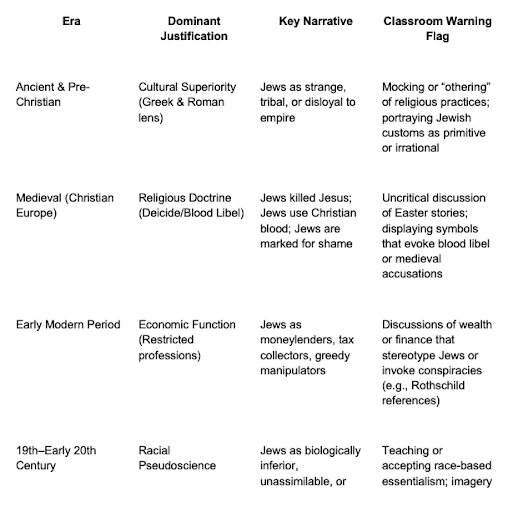
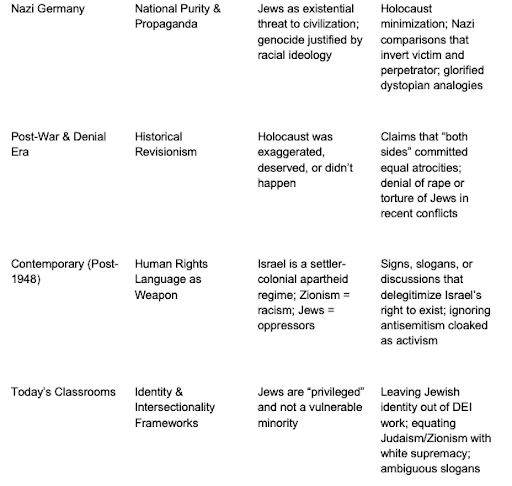
Mini Toolkit: Recognizing Antisemitism’s Evolution
Understanding how antisemitism has adapted across time helps educators identify it when it surfaces—whether overtly or in coded, socially acceptable forms.
Final Takeaway
At times, antisemitism is easily identifiable. Other times, it can be hard to detect. When examining the past patterns, antisemitism manifests when an attribute of Jews is placed in the forefront of being “the problem.”
In the times when religion was the highest authority, they said, “We do not hate the people of Judea. We only disapprove of their religion: Judaism.” When science became the highest authority, they said, “We do not hate Jews. We only disapprove of their inferior race: Semites.” When human rights became the highest authority, they said, “We are not antisemitic. We do not hate Semites, we only hate their cause: Zionism.”

Comment Below
Please comment below with edits or suggestions on what should be changed in this post.
Please keep your comments civil. Comments are moderated.
If you spot any comment out of line, let me know.
Join My Safe Schools for Jewish Students Newsletter
If you’re new here, subscribe to stay updated on new blog post excerpts of Safe Schools for Jewish Students: An Educator’s Guide to Preventing Antisemitism and Strengthening Belonging.
Sign up for my newsletter here.
Author Biography of Safe Schools for Jewish Students
Ezra Barany loves riveting readers with Jewish thrillers. His first two books in The Torah Codes series were award-winning international bestsellers. In his free time, he has eye-opening discussions on the art of writing novels with his wife and book coach Beth Barany. A high school physics teacher, Ezra lives in Oakland with his beloved wife and two cats working on the next book. Ezra, not the cats.
0 comments